
Weekly Energy Update · Edition 2
This week in energy: gas round-tripped, and the cold is coming
Friday 20 November 2026
Wholesale gas went up and came back down in five days. Business electricity is forecast to rise more than 25 per cent by 2030 and network charges are heading for 40 per cent of the bill. And the cold arrives this weekend, which is the first real test of a European gas store that is emptier than at any point on record for the date.
What moved
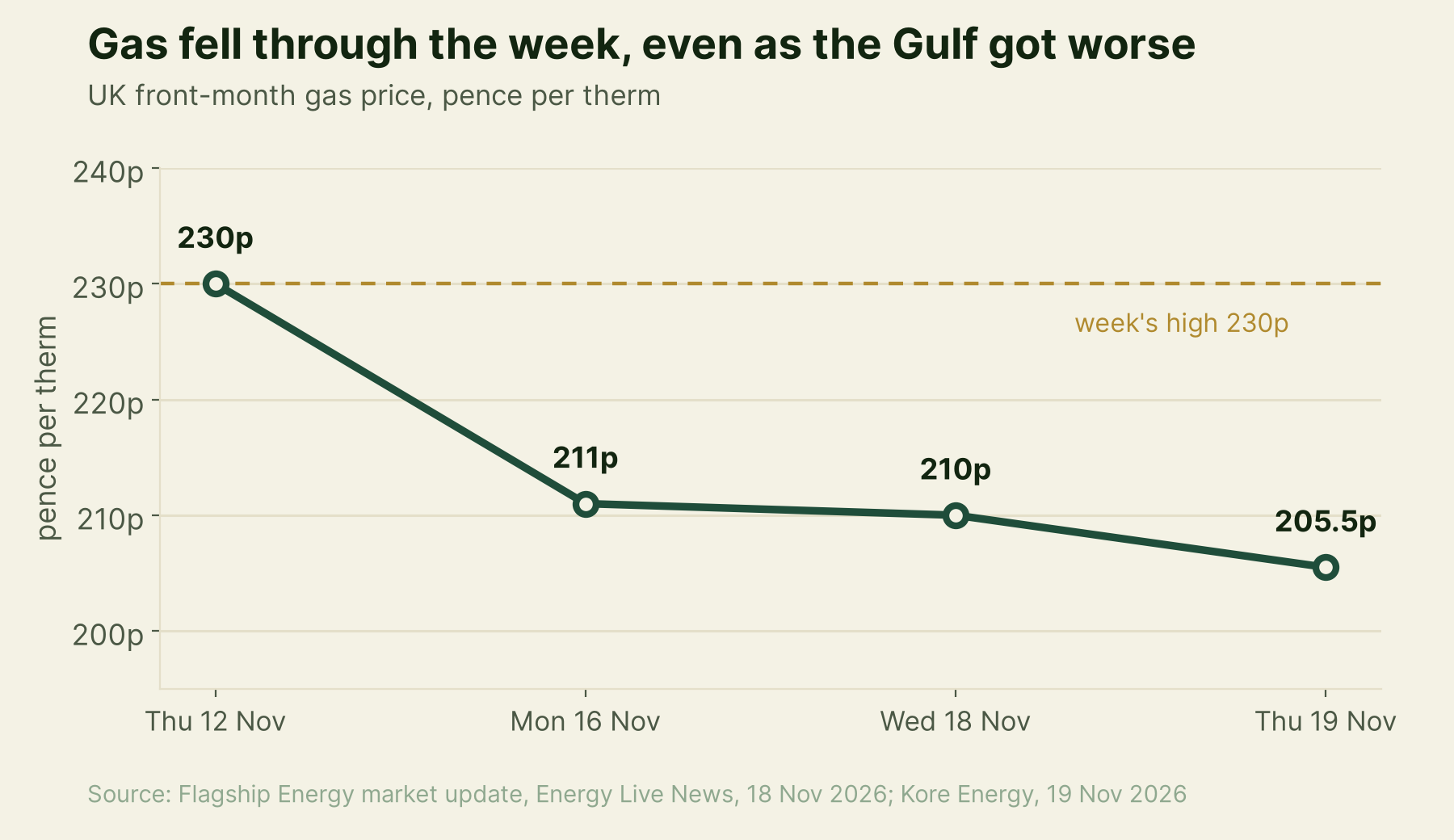
Front month gas hit 230 pence a therm on Thursday, fell to 211 by Monday, and was 205.5 by Thursday morning. That is a round trip, not a fall. Gas for the first quarter of next year is down 3.3 per cent on the week.
Electricity went the other way. The December power contract hit £198 a megawatt hour, testing £200, before giving back £21 by Monday. Day ahead rose to £190 as wind fell towards 8 gigawatts against a normal nearer 10.
Why
Supply is arriving. Liquefied gas flows into US export plants hit a record on Saturday, cargoes bound for north east Asia are being drawn to Europe instead, and Germany switched on its terminal at Stade.
Risk is rising. US aircraft struck a missile site at the mouth of the Strait of Hormuz, Iran struck back across the Gulf, and two tankers were hit near Oman. Traffic through the strait is around 65 per cent below where it was before the war.
The market chose supply for most of the week.
What it costs you
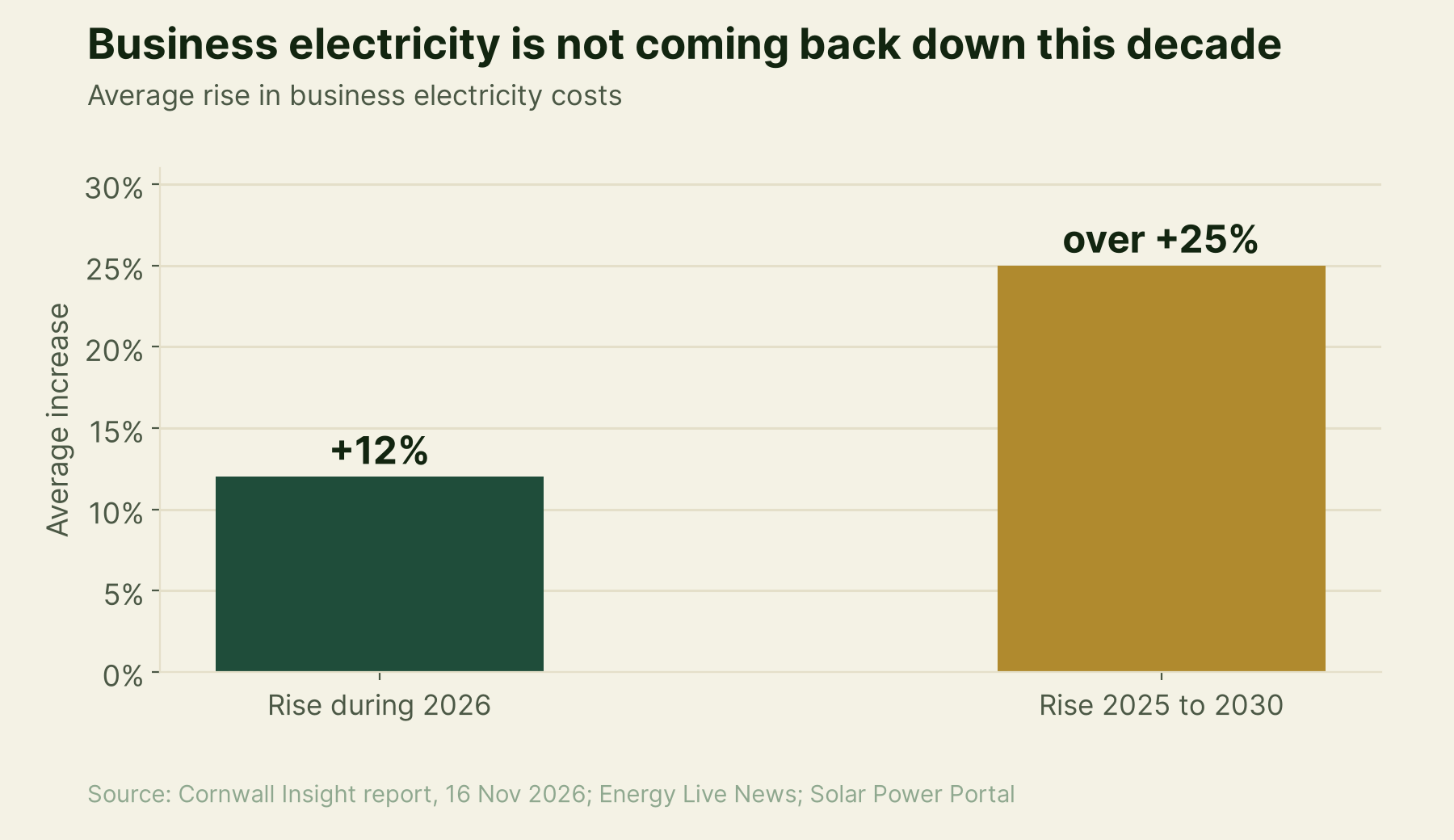
Business electricity rose around 12 per cent this year. It is forecast up more than 25 per cent between 2025 and 2030, and is not expected back to 2025 levels before 2031.
The reason matters more than the size. Network charges, the part that pays for the wires and the system behind them, go from about 25 per cent of the average business bill today to more than 40 per cent by 2030.
That is the part you can influence, because those charges are driven by when you draw power and how hard, not just how much. The two that matter are DUoS and TNUoS, and both are built around peak demand. Flatten the peaks and you pay less for the same energy.
For context, the domestic price cap is forecast to rise 26 per cent in January. It is a different mechanism and it does not set your contract, but it is the same wholesale market underneath, so directionally it tells you the same thing.
Last week's power
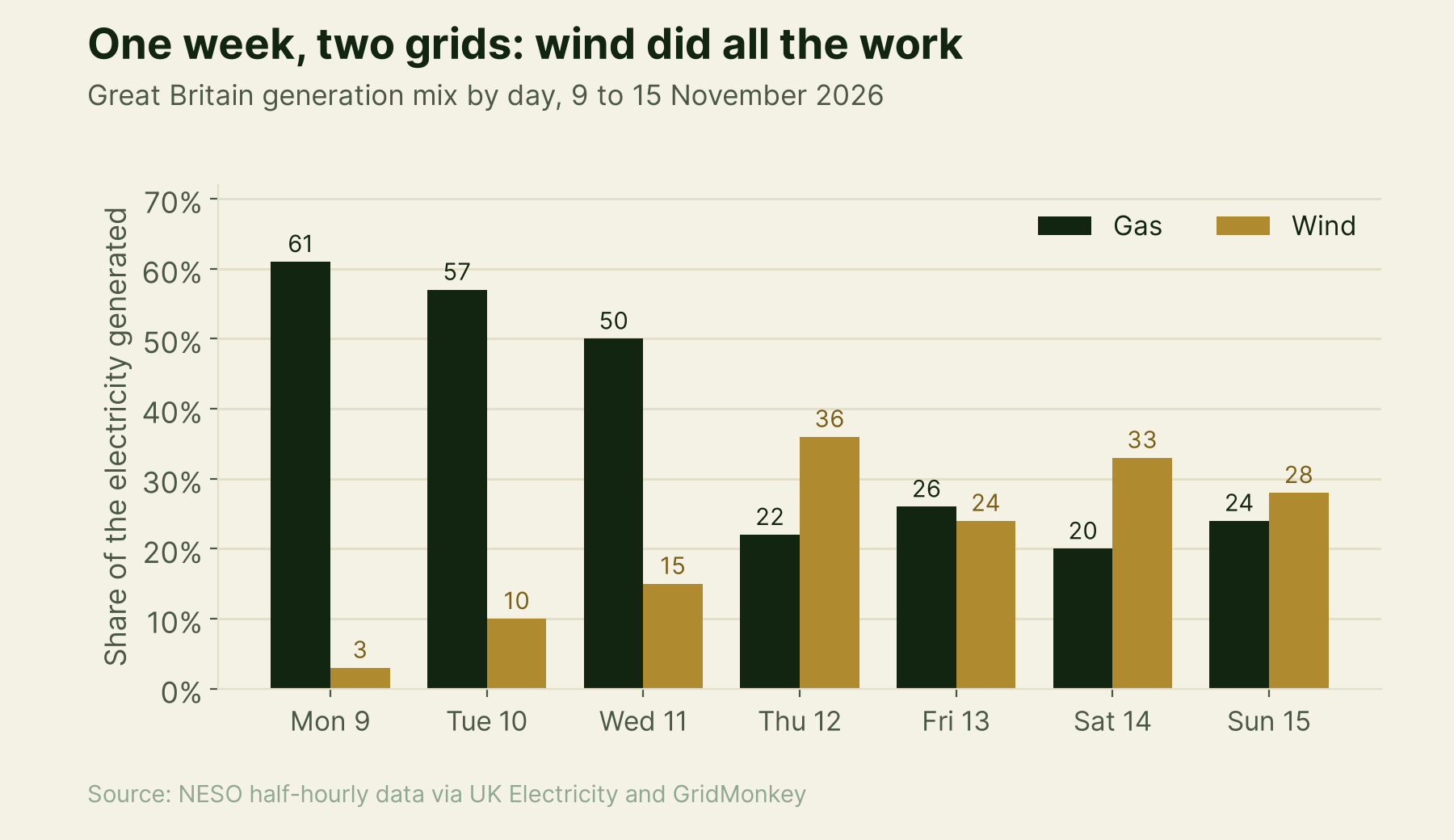
Gas and wind supplied roughly equal shares, and the balance swung violently. Monday: gas 61 per cent, wind 3. Thursday: wind 36, gas 22. Carbon followed the wind, averaging 261 grams of carbon dioxide a kilowatt hour on Monday and 113 on Saturday. Same grid, same week, less than half the carbon.
The week ahead
Temperature is forecast about 2.5 degrees below normal by Saturday, with each run colder than the last. Wind drops towards 4 gigawatts. Cold weather alerts are out for the North West, the North East and Yorkshire.
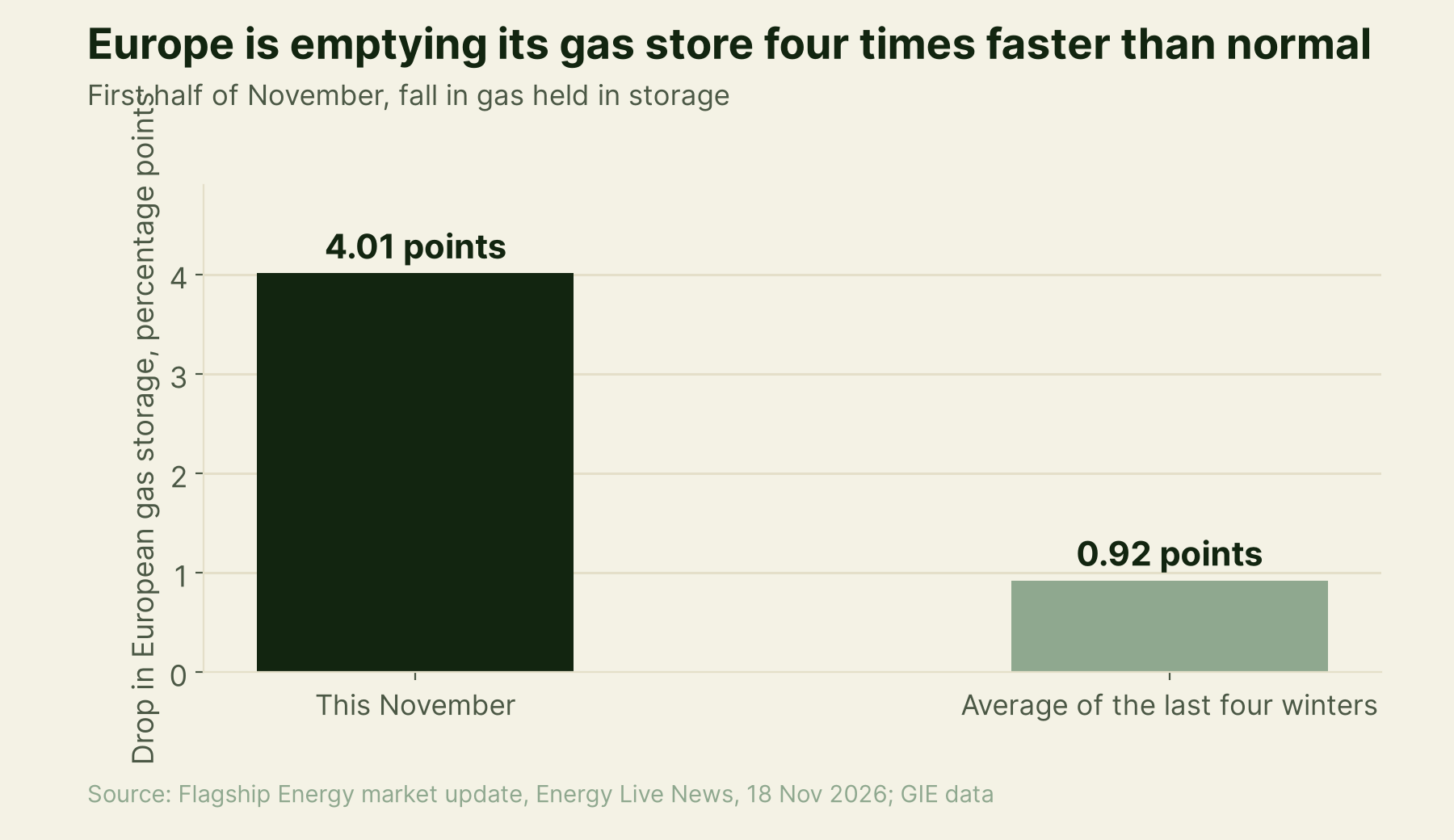
Cold and still is the combination that empties storage. Europe is at 70.15 per cent, the lowest for that date since records began in 2011, having drawn down four percentage points since the start of November against a normal of less than one.
One piece of good news: gas started flowing from the Jackdaw field on Sunday. It cost £2.1 billion, it is welcome, and it is small.
On Friday
The UK and the EU are expected to sign a deal linking their carbon markets. The government puts the benefit at up to £3.8 billion a year to the UK economy, and around £6.5 billion of steel and aluminium exports protected from the EU carbon border charge.
When to buy
Gas is back to where it was before the run to 230, and next summer is cheaper again. If your contract renews inside six months, these levels are defensible, and spreading the purchase across several dates still beats committing on one day.
The risk is not symmetrical though. Storage is at a record low for the date, the weather turns colder, wind is forecast to drop, and the Gulf is not resolving. The downside looks limited and the upside looks live.
Technology this week: solar on a heat pump project
A heat pump delivers about three units of heat per unit of electricity, which is why it cuts carbon and running cost. But it moves the energy onto your electricity supply, so more power goes through the meter, and you pay twice: in the unit rate, and in the peak demand that sets your network charge.
Solar on the roof deals with both. It generates in the day, when the building is occupied and when a heat pump works hardest in spring and autumn. UK studies put the share of a heat pump's annual electricity that solar covers at a quarter to a third, and more with a battery.
So if a project has a heat pump, the solar belongs in the same conversation and the same budget.
The takeaway
Prices are not falling in a straight line. The cost is shifting from the energy itself to the network charges around it, and that is the part you can influence. And electrification means more power through your meter, not less.
Market commentary only, not energy procurement advice.
Sources: Flagship Energy market update, Energy Live News, 18 November 2026 (gas 230p high 12 Nov, 211p Monday close, 210p 18 Nov morning, Q1-27 206p -3.3%, Summer-27 155p -1.3%, Q1-27 power £174/MWh -4.4%, Dec-26 power high £198/MWh, day-ahead £190/MWh, wind near 8GW vs normal 10GW, Brent $92, TTF €89/MWh, storage 70.15% 18 Nov, drawdown 4.01pts vs 0.92 average, Reuters finish-March 21.5%, Gulf escalation detail, Tara Gas, ADNOC vessel, US export flows 21.8bcf/d record +12%, Stade 14mcm/d, Norway 337mcm/d, COT +18.0TWh vs 5.9TWh, net length 172.6TWh, temp 2.5C below normal by 21 Nov, wind to 4GW, Visund zero to 1 Dec); Kore Energy, 18 and 19 November 2026 (front month 205.51p, -7.01p on previous close; Summer-27 152.00p; Brent $92.27); Cornwall Insight press release, 18 November 2026, and The Guardian, 18 November 2026 (January 2027 cap +26%, £1,723 to £2,166, +£443, Ofgem announcement 25 November 2026); Cornwall Insight, 16 November 2026, via Energy Live News and Solar Power Portal (business electricity +12% in 2026, +25% 2025-2030, network charges over 40% of pre-VAT bill by 2030 vs 25% today, not back to 2025 levels before 2031); NESO Gas Supply Security Assessment 2026, published 18 November 2026, via NESO, Energy Live News, Energy Voice and Carbon Recycling (supply sufficient for almost all demand in 2031/32 and 2036/37 with all sources available; risk if the largest infrastructure is lost; narrow N-1 failure by 2036/37); Adura, 16 November 2026, and BBC News, 16 November 2026 (Jackdaw first gas, Shell and Equinor joint venture, £2.1bn, Shearwater to St Fergus); GOV.UK, UK-EU summit package factsheet and mythbuster, 17 November 2026 (up to £3.8bn a year, £6.5bn of steel and aluminium exports protected from CBAM, no EU budget payment); NESO Carbon Intensity data via UK Electricity (ukelectricity.app/history/2026/11) and Carbon Recycling, 15 November 2026 (daily generation shares, carbon intensity 113 to 261 g/kWh, November month to date shares, 17 November windiest at 383.5GWh and 40.6%); Suffrago UK Data Hub, GB generation mix, week 9 to 15 November 2026 (gas 33.6%, wind 28.1%); UK Health Security Agency cold-health alerts, via GOV.UK and Sky News, 15 November 2026; SSE, via Yorkshire Post and The Guardian, 18 November 2026 (Atwick rewatering from summer 2027 without government support); RenewableUK EnergyPulse, 21 October 2026 (8.7GW operational, 14.1GWh; 9.1GW under construction, 19GWh); Ember, Harnessing the Winds, November 2026, via Energy Live News 16 November 2026 ($105/MWh to $86/MWh at 90% uptime); Heat pump and solar performance: energy.org.uk, UKEM, solarblog.co.uk and Nesta (heat pump SPF around 3.0, gas boiler around 90%, solar covering 25% to 36% of heat pump demand, higher with battery); BICS: GOV.UK British Industrial Competitiveness Scheme applicant guidance (window closes 30 November 2026, £35 to £40 per MWh average saving, assessed per manufacturing site).